Textile Waste Collection and Community Upcycling in Quezon City
A practical local guide for Quezon City businesses, schools, organizations, communities, and residents seeking responsible textile recovery, donation, or upcycling pathways connected to Payatas.
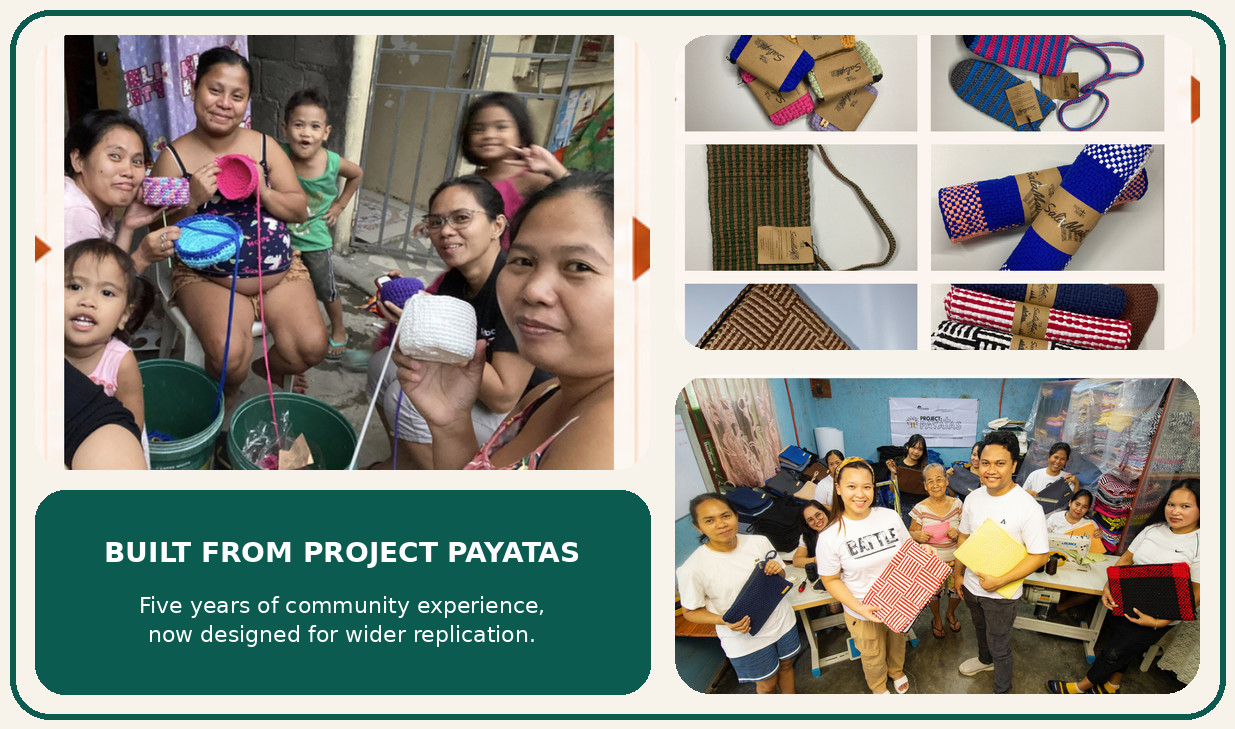
Quezon City has several textile-circularity pathways
Quezon City is developing a more organized local approach to textile circularity. The city has established a Textile Sustainability and Circularity Program and supports collection, sorting, repair, repurposing, recycling, livelihood, and circularity hubs. A QC and ANTHILL Textile Circularity Hub is located at the Payatas Controlled Disposal Facility.
Project Pilipinas is a separate, community-rooted initiative. It is not the operator of the Quezon City Government program and does not represent the QC and ANTHILL hub. Project Pilipinas grew from the operating experience of Project Payatas and is developing a wider system for textile recovery, community production, traceability, partner reporting, and future material pathways.
Choose the right local pathway
Not every textile belongs in an upcycling workshop. The best route depends on condition, ownership, risk, and whether a real next use exists.
Project Pilipinas assessment
For companies, institutions, organized groups, and partners that can provide material details, photographs, approximate volume, location, timeline, and desired outcome.
Project Payatas production
For suitable upcycled product orders and selected materials that match current maker skills, product demand, quality requirements, and available capacity.
Quezon City Government programs
For official city initiatives, the QC and ANTHILL Textile Circularity Hub, RePorma, training, and city-wide announcements. Refer to official Quezon City pages.
Donation or resale channels
Clean wearable clothing may be better suited to direct reuse, family networks, resale, clothing swaps, or qualified donation organizations than to cutting or recycling.
Materials and preparation guidance
This table describes Project Pilipinas screening guidance. Official city programs and other organizations may use different acceptance rules.
| Material | Current Project Pilipinas guidance | Preparation before inquiry |
|---|---|---|
| Clean fabric offcuts | Potentially useful when material type, piece size, color, and volume are consistent | Keep dry, separate by fabric type when possible, remove trash, and provide photographs with a size reference. |
| Corporate or school uniforms | Accepted only after branding, ownership, condition, quantity, and intended output are reviewed | Separate by uniform type, identify logos and name patches, and do not include contaminated items. |
| Curtains and household fabric | Case-by-case assessment based on cleanliness, dimensions, coating, and demand | Wash when appropriate, dry completely, identify stains or mold, and measure representative pieces. |
| Clean hotel or institutional linens | Case-by-case assessment with hygiene and source controls | Confirm that materials are clean and free from biological, chemical, pest, or hazardous contamination. |
| Wearable clothing | Often better suited to direct reuse, donation, swapping, or resale | Sort wearable items separately and use an appropriate reuse channel when available. |
| Mixed household clothing | Not automatically accepted by Project Pilipinas | Do not deliver unsorted bags. Contact the intended recipient and follow its published acceptance rules. |
| Wet, moldy, infested, or contaminated textiles | Not suitable for community handling | Keep separate and consult the appropriate waste, sanitation, or specialist service. |
| Foam, leather, shoes, hard accessories, and mixed non-textiles | Outside the ordinary textile-upcycling stream unless specifically approved | List all components and provide photographs before transport. |
How to arrange a responsible local collection
Identify the most suitable route
Decide whether the material is still wearable, useful as fabric, suitable for a product order, or too damaged for the available community pathway.
Contact the correct organization
Use official Quezon City channels for city programs and use Project Pilipinas channels for Project Pilipinas assessments and partnerships.
Describe the material clearly
Provide textile type, source, approximate weight or count, condition, location, photographs, storage situation, and expected collection period.
Wait for written acceptance
Do not leave materials at a workshop, community site, government facility, or private address without confirmation from the receiving organization.
Prepare clean and dry materials
Keep textiles protected from rain, pests, dirt, and mixing with food waste or other residual waste.
Label and segregate
Separate uniforms, linens, offcuts, wearable clothing, contaminated items, and non-textile components to reduce sorting time and risk.
Arrange delivery or collection
Confirm date, loading access, contact person, vehicle requirements, packaging, costs, and what happens to rejected material.
Request documentation when needed
For organizational programs, agree on weight records, sorting results, destination reporting, photographs, product outputs, and data limitations.
Collection models for Quezon City organizations
A successful drive begins with a confirmed destination and an operational plan, not with a public collection announcement.
| Organizer type | Useful collection model | Controls to include |
|---|---|---|
| Condominium or homeowners association | Time-limited, pre-registered collection with published accepted items | Assigned coordinator, dry holding area, labeled containers, capacity limit, and confirmed recipient. |
| School or university | Uniform or textile-specific drive linked to education and a defined destination | Ownership consent, prohibited items, student privacy, brand controls, collection period, and adult supervision. |
| Office or company | Employee uniform return, fabric-offcut program, or scheduled institutional turnover | Internal inventory, branding plan, collection responsibility, transport budget, and approved report format. |
| Barangay or community organization | Small pilot focused on one clearly defined textile stream | Receiving partner confirmation, sorting volunteers, health and safety rules, storage, and a plan for rejected items. |
| Retailer or manufacturer | Recurring clean offcut or deadstock stream with regular documentation | Material specification, contamination controls, minimum usable dimensions, frequency, and market or production demand. |
| Event organizer | Pre-event plan for shirts, banners, fabric décor, costumes, or booth textiles | Ownership, post-event collection point, segregation, deadline, and product or donation destination. |
Payatas experience and community production
Payatas has long been associated with waste and recovery work, but textile circularity requires more than moving materials into the community. A useful system connects clean material, appropriate skills, safe storage, product design, buyer demand, quality control, fair production payment, and transparent reporting.
Project Payatas provides practical experience in home-based and community production. Project Pilipinas is intended to build on that experience by connecting textile owners, community makers, buyers, technical partners, and future recovery facilities. The goal is to route each textile to the most appropriate available next use rather than force all materials into one product or process.
Public information and official sources
Official Quezon City references
Quezon City describes the QC Textile Circularity Hub as a partnership with ANTHILL Fabric Gallery at the Payatas Controlled Disposal Facility. The city also states that its Textile Sustainability and Circularity Program supports collection, sorting, repair, repurposing, recycling, and livelihood through circularity hubs. See the city’s official ordinance announcement.
These links are provided for public information. Project Pilipinas is not representing or operating the city program.
Quezon City textile collection questions
Local collection options and capacities can change. Confirm current requirements directly with the relevant organization.
The correct recipient depends on the fabric type, cleanliness, piece size, quantity, and intended use. Contact Project Pilipinas for an assessment, or consult official Quezon City channels for city-run programs. Do not deliver materials without written acceptance.
Project Pilipinas has limited capacity and does not operate an unrestricted household clothing drop-off. Wearable clothing may be better suited to reuse, resale, swapping, or a qualified donation program. Contact us before sending non-wearable fabric.
Possibly, subject to the textile type, volume, location, access, transport cost, storage, collection schedule, and confirmed destination. A pre-assessment is required.
A barangay can explore a focused pilot only after a receiving partner, accepted-material list, storage plan, sorting process, collection limit, transport plan, and rejected-material route are confirmed.
No. Project Pilipinas is a separate initiative rooted in Project Payatas. Questions about the city-operated hub should be directed to the Quezon City Government.
School uniforms may be assessed when ownership, branding, condition, quantity, safety, and the intended next use are clear. A school should obtain internal approval before transferring identifiable uniforms.
There is no universal free-collection commitment. Transport, loading, sorting, storage, de-branding, reporting, and production may have costs depending on the project.
Materials are received under an agreed process, weighed or counted, sorted, and routed to reuse, community production, a documented partner, a future technical pathway, return, or rejection. Collection alone is not reported as verified diversion.
Related Project Pilipinas resources
Discuss a Quezon City textile stream
Send photographs, material type, approximate weight or count, barangay or location, condition, timeline, and the outcome you are seeking.