About
Project Pilipinas is a pilot-stage textile circularity initiative growing from the community experience of Project Payatas. It is designed to connect textile waste generators, community makers, buyers, recovery partners, and future material innovators through one organized system.
From Payatas to a wider circularity ecosystem
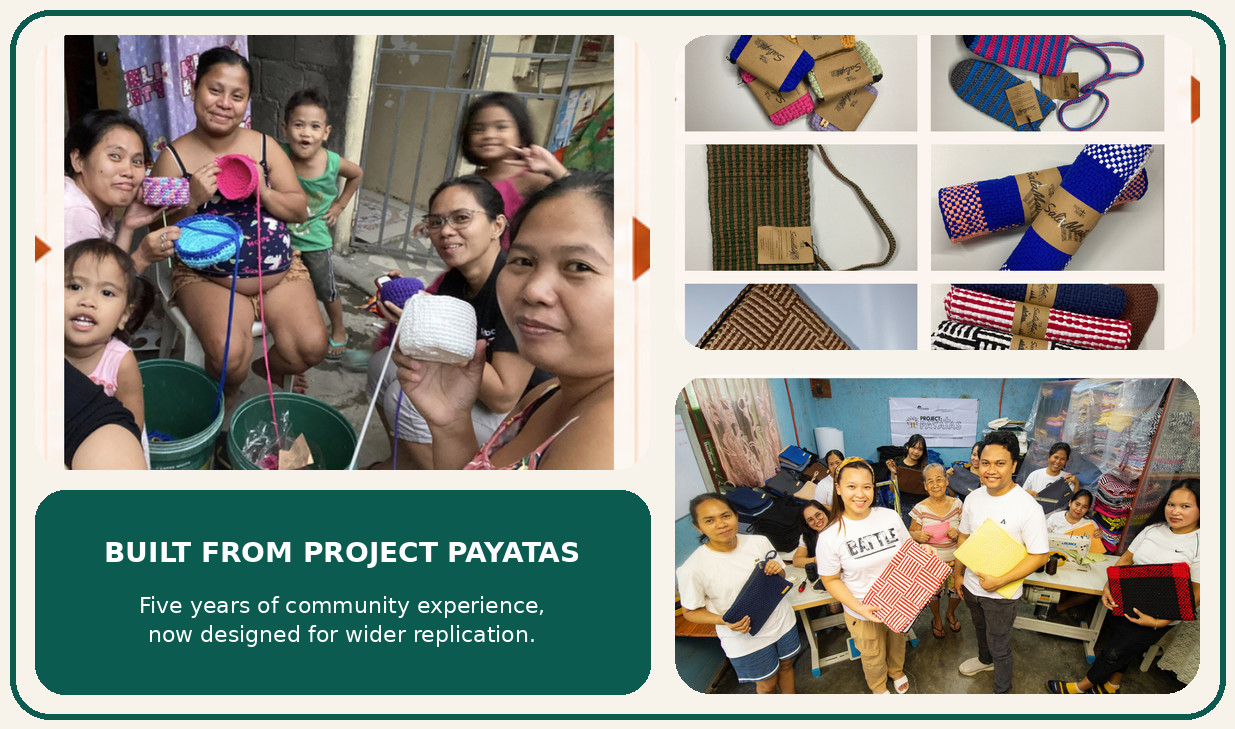
Project Payatas began through community outreach in 2021 and formally evolved into a social enterprise in 2022. Its home-based production model showed that discarded textiles can become useful products, flexible livelihood, and community leadership opportunities. Project Pilipinas builds on this foundation by organizing collection, sorting, traceability, community production, and future material recovery for wider replication.
We connect waste to the right next use
Community roots, measurable progress
Our direction is shaped by practical experience: working with mothers, handling inconsistent textile materials, producing marketable products, fulfilling orders, improving quality, and measuring both livelihood and environmental results.
Our Milestones
Project Payatas started through Bible studies and community outreach, building relationships with families and identifying the need for flexible livelihood around caregiving.
The initiative began collecting surplus textiles and using a decentralized, home-based production model for community mothers.
Internal records show 2,803 kg of textile waste diverted, ₱411,624 in gross livelihood payouts, approximately 30–40 active mothers, and more than ₱1.2 million in annual sales.
The next stage focuses on partner textile recovery, improved sorting and traceability, community replication, clean-tech integration, and future material pathways such as BRIXFab.
What our work is designed to change
Our goal is not only to count materials collected or products made. We are building a system that can show what happened to textile waste, how market demand supported community production, and what changed for participating women and partners.
How We Measure Progress
Environmental accountability
“We count textile diversion only when materials are weighed, logged, and confirmed as used in products or routed through a documented circular pathway.”
Verified material movement
Project Pilipinas measurement principle
“We measure livelihood beyond participation by tracking gross payouts, net income, payment continuity, production costs, and the ability to earn around caregiving.”