Why the Philippines Needs a Connected Textile Recovery System
Posted in :

Textile waste, community upcycling, and corporate sustainability efforts already exist in the Philippines. The challenge is connecting them through an organized recovery, production, traceability, and material-innovation system.
Textile waste does not need another isolated solution
Companies, institutions, retailers, manufacturers, and households all generate textiles that are no longer needed. Some materials remain usable, while others are damaged, mixed, branded, or difficult to process. At the same time, community groups and small upcycling enterprises already have the skills to transform selected textiles into useful products.
The problem is not the absence of effort. The problem is that collection, sorting, community production, market demand, material processing, and reporting often happen separately. Without a connected pathway, usable textiles may remain stored or be discarded, while community makers struggle with inconsistent materials and uncertain orders.
Why reuse comes first
Project Pilipinas is being designed around a reuse-first principle. When a textile can still be cleaned, cut, redesigned, woven, or sewn into a higher-value product, that option should be assessed before shredding or lower-value processing.
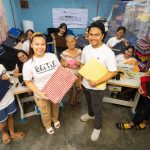
Reuse preserves more of the material’s original value. It can also create products, orders, skills, and income for community makers. Through Project Payatas, this approach has already supported home-based production of mats, bags, pouches, sleeves, kitchen accessories, corporate gifts, and other useful items.
Where communities create value
Community participation is not intended to be an add-on after collection. It is one of the core pathways of the system.
Reusable materials can be sorted according to what different groups can handle. Production can then be matched with real buyer demand, available skills, tools, quality standards, and delivery timelines. This approach is designed to prevent communities from receiving materials without a clear product or market pathway.
Project Payatas provides the operating foundation for this model. In 2025, internal records show 2,803 kg of textile waste diverted, ₱411,624 in gross livelihood payouts, approximately 30–40 active mothers, and more than ₱1.2 million in annual sales.
Why traceability matters
Collection alone does not prove circularity. Partners need to know what was received, how much it weighed, how it was classified, where it went, and what outcome was created.
Project Pilipinas plans to build simple records from intake to final pathway. These may include material source, weight, condition, sorting result, community or processing destination, products created, and livelihood supported. Materials that are merely stored or waiting for a pathway should remain recorded as inventory rather than being reported as diverted.
One ecosystem, two pathways
The proposed system has two main material streams.
Stream A: Reuse and upcycle. Textiles in usable condition are prepared for redesign, community production, customized orders, and other higher-value applications.
Stream B: Shred and recycle. Damaged or unusable textiles are reserved for approved shredding and material-development pathways, including possible insulation, partitions, panels, stuffing, and future BRIXFab applications.
Both streams require collection, sorting, quality checks, documentation, partners, equipment, and market demand. The goal is not to force every material into one solution, but to direct it to the most practical documented pathway available.
What the pilot needs to prove
The Project Pilipinas pilot must demonstrate that the model can consistently collect and classify materials, connect reusable textiles to community production, build demand for products and services, record livelihood and environmental outputs, and establish safe pathways for damaged textiles.
The pilot will also test what partners need from onboarding, logistics, secure handling, reporting, and communication. These lessons will determine how the system can be improved and replicated in other communities or cities.
A circular future must be connected
Textile circularity is not only about preventing waste. It is about connecting materials to people, products, information, and innovation.
Project Pilipinas is being built to make those connections practical: from textile generators to a recovery hub, from usable materials to community makers, from damaged textiles to future material solutions, and from every activity to clearer impact data.